

India has emerged as one of the most promising destinations for entrepreneurs and multinational corporations seeking to expand their global presence. With a fast-growing economy, abundant skilled workforce, digital advancement, and favorable government initiatives like Make in India and Ease of Doing Business, the country continues to attract substantial foreign investment.
In 2022, India ranked third globally for new (Greenfield) FDI projects, reaffirming investor confidence and its robust business ecosystem.
Whether you are an Indian entrepreneur or a foreign investor, our team at PGAS & Associates offers comprehensive support for business setup and company formation in India — from entity structuring and legal registration to compliance and operational readiness.
Entrepreneurs can set up either a Private Limited Company or Public Limited Company, allowing variations like:

Combining features of a Partnership Firm and a Company, LLP permits 100% FDI investment through the Automatic Route

It is the set-up for carrying out Import, Export, Research, and execution of projects. It can be registered as:

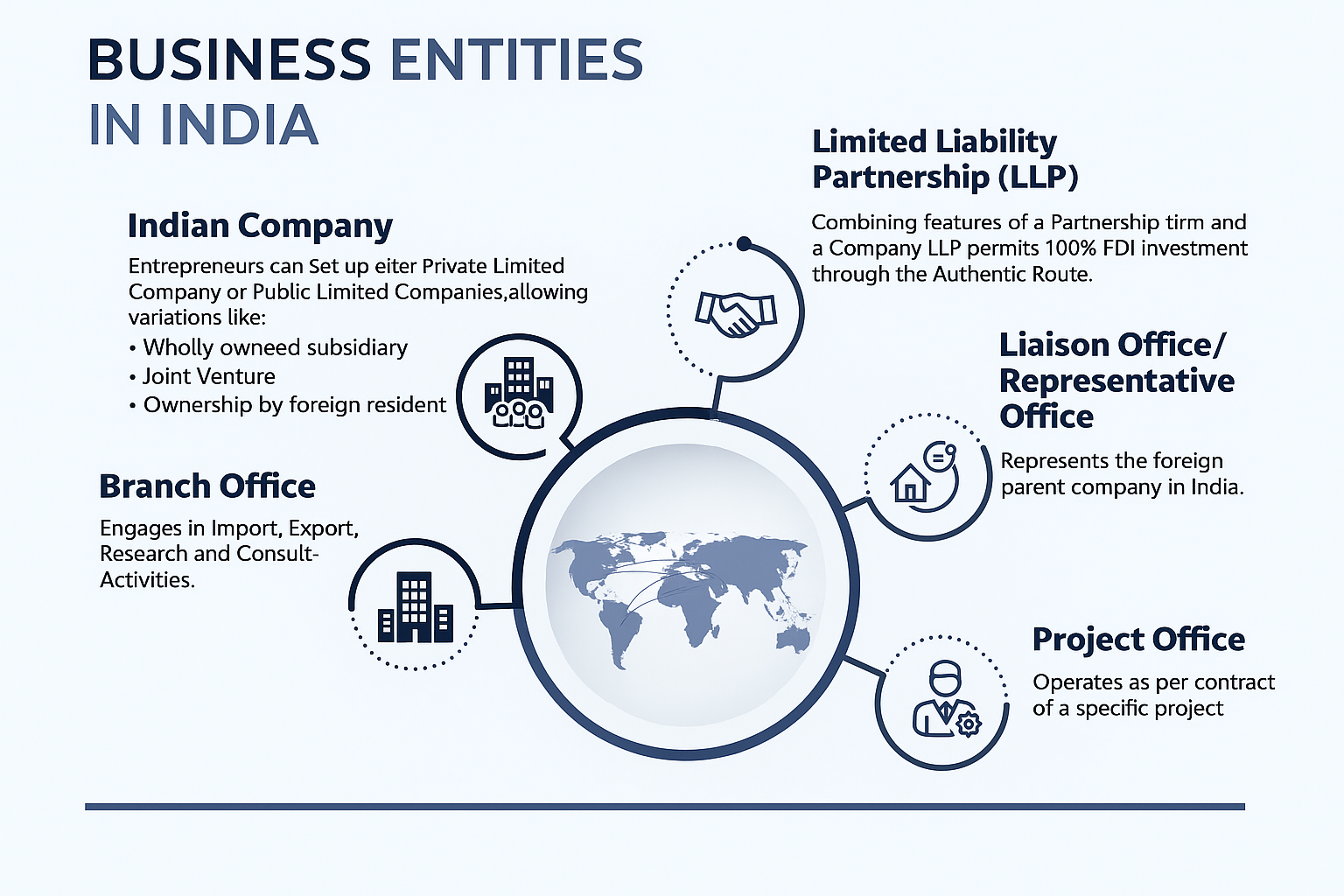
Setting up a business in India involves adherence to specific rules and regulations. Refer to the following chart for comprehensive details on how to establish your own company in India.
| Particulars | Wholly Owned Subsidiary | Joint Venture | Ownership by Foreign Individual |
| About | A company wholly owned, managed, and controlled by the parent company | An arrangement between multiple parties forming a separate legal entity, e.g., a Company, LLP, or partnership | A company wholly owned, managed, and controlled by the foreign individual/s |
| Ownership | Solely owned by the parent company | Shared ownership among entities forming the Joint Venture | Solely owned by the foreign individual |
| Control & Management | By Parent company | Governed collectively by all involved entities through a Joint Venture Agreement | By foreign individual |
| Taxation | India | India | India |
| Liability | Parent company not personally liable for subsidiary’s debts and obligations | Entities share responsibilities jointly or severally based on the agreement for the obligations of the Joint Venture | Foreign individual not personally liable for Indian company’s debts and obligations |
| Particulars | One Person Company (OPC) | Private Limited | Public Limited | LLP |
| Governing Act/ Law | Companies Act, 2013 | Companies Act, 2013 | Companies Act, 2013 | LLP Act, 2008 |
| Separate legal Identity | Yes | Yes | Yes | Yes |
| Defaults Liability | Directors | Directors | Directors | Designated Partners |
| Members Min/Max | 1/1 | 2/200 | 7/No Limit | 2 Designated Partners/No Limit |
| Directors Min/Max | 1/15 | 2/15* | 3/15* | 2 Designated Partners/No Limit |
| Resident Director# | 1 Mandatory (NRI permitted) | 1 Mandatory | 1 Mandatory | 1 Designated Partner |
| Public Subscription of shares | Not allowed | Not allowed | Allowed | Not allowed |
| Income Tax Rate** | Ranging from 17.16% to 34.94% | Ranging from 17.16% to 34.94% | Ranging from 17.16% to 34.94% | Ranging from 31.20% to 34.94% |
| Audit | Mandatory | Mandatory | Mandatory | Mandatory* (limit based) |
* After passing a special resolution in a general meeting, a Company may appoint more than 15 directors.
** (including surcharge and education cess)
# Resident Director: Every company should have at least one director who has stayed in India for at least 182 days in the financial year (120 days in the case of LLP and OPC) and in each subsequent year.

Every business starts somewhere. For some, it’s a garage. For others, it’s a spare room, a laptop, and one determined individual. If you’re someone who has been running your show solo and wants to elevate things legally, then a One Person Company (OPC) might just be the right step forward.
It is suitable for individuals who don’t yet have a co-founder or partner. It’s an ideal choice for solo entrepreneurs, freelancers, or consultants who want to move beyond the informal setup of a sole proprietorship.
A One-Person Company (OPC) is a private limited company for solo entrepreneurs. It lets a single individual own and manage the entire business—no partners, no shared ownership—while enjoying the perks of a structured legal entity. Introduced under the Companies Act, 2013, OPCs were created to give individual business owners the legal identity, credibility, and limited liability protection typically reserved for larger setups. Whether you’re providing services, selling products, or launching a startup, registering as an OPC gives your business the formal structure it needs, without adding unnecessary complexity.
OPCs offer a smart upgrade for solo entrepreneurs who want more than an informal setup. Rather than operating as a sole proprietorship, registering as a One-Person Company gives your business a formal identity, legal backing, and the freedom to scale with confidence.
Here’s what makes OPCs a powerful choice:
Benefits of OPC
Eligibility
A public company is an entity, the ownership of which is disseminated to the general public in the form of shares or securities that are freely traded on any stock exchanges or over-the-counter exchanges or can be acquired privately through an Initial Public Offering (IPO)
The model of a public limited company (Pvt Ltd..) provides a huge platform for entrepreneurs to expand their business horizons nationally as well as internationally. A public company can raise money from the general public, and they have a full stake and interest in the company.
Key Features:
Benefits:
Incorporation Process (Basic)
For companies with up to 7 promoters, incorporation is done online through the SPICe+ form as per Rule 38 of the Companies (Incorporation) Rules, 2014.
Key Features:
Benefits
Key Characteristics
Requirements to Register an LLP
Registration Process
Documents Needed
For partners:
For registered office: